Anúncios
Can simple software and smart workflows really cut waste, boost orders, and free your staff to focus on guests? That question sits at the center of today’s shift in the food industry.
Think less sci‑fi robots and more practical systems: virtual tools now handle repetitive tasks like email campaigns, phone intake, and reporting.
House of Pizza tripled marketing impressions and lifted online orders by 32% with automated email and content. Ocean State Sandwich Company generated $42,000 in online sales the same way.
Kiosks, first‑party ordering, and integrated POS cut manual entry and errors, while inventory forecasting fights the roughly $25 billion lost to waste in the U.S.
This guide will show where to slot these tools into your kitchen and operations, what costs and ROI to expect, and how to keep the human touch so your customers still feel cared for.
Anúncios
Why restaurant automation is rising right now
You’re operating in a tighter labor market: full‑service kitchens now run with about 6.2 fewer employees on average. That gap forces you to find ways to keep service levels stable without burning out the team.
Rising costs and supply volatility make forecasting harder. Using data and POS analytics helps you buy smarter and prep less waste. Tejano BBQ Burrito, for example, uses product usage and purchase timing to improve ordering decisions.
Guest expectations also shifted. Customers want faster answers, shorter wait times, and seamless digital options. When you route calls, enable first‑party ordering, or use simple marketing automation, staff spend more time with guests and less on repetitive tasks.
- You can protect margins by cutting rework and errors.
- Half of U.S. restaurants plan to adopt these tools soon, and most operators called technology vital during the pandemic.
- Start small—use marketing and POS analytics first—then expand to back‑of‑house inventory and order management.
For a practical primer on choosing automation tools and planning rollout, see automation tools that match your goals.
The business case for automation: benefits, risks, and real-world impact
You can see measurable gains when ordering, prep, and inventory share a single stream of data. That link reduces manual entry, shrinks remake orders, and makes production in the kitchen more predictable.
Key advantages you can bank on
Efficiency improves as orders move faster from front to back, raising table turns and daily revenue.
Accuracy rises when your POS, inventory management, and reporting share data, cutting reconciliation time and costly mistakes.
Safety improves with automated controls that limit staff exposure to hazards, while robots handle narrow, repetitive tasks.
Higher sales follow from better marketing and consistent follow-up—House of Pizza and Ocean State Sandwich Company show how email and content can lift orders and revenue.
Trade-offs to weigh
Expect upfront costs and a learning curve. Set clear business goals and timelines so you can measure ROI and avoid tools you won’t use.
Current systems lack complex judgment, so keep human touchpoints where guest experience matters most. Use data-driven inventory management to cut waste, which costs the industry billions each year.
- Quantify gains with faster flow, fewer remakes, and clearer production.
- Plan labor shifts thoughtfully—reassign staff to service and management roles.
- Be transparent with customers about changes to preserve a warm dining experience.
How to adopt automation the smart way: your step-by-step roadmap
Start with a simple workshop to map how orders, prep, and delivery actually flow through your operation. That map shows where guests wait and where staff repeat tasks. Use it to set clear, measurable goals for the next quarter.
Assess operations and set goals
Walk shifts, collect simple data, and list bottlenecks in FoH, BoH, and delivery. Translate problems into business goals: shorter ticket times, fewer remakes, or less waste.
Choose your stack and integrate
Build around your POS. Add a KDS, inventory tracking, and self‑service flows where they help most. Pick platforms and tools that share data so you avoid double entry.
Train, track, and secure
Create short playbooks and phased rollouts so staff adopt change with minimal friction. Track KPIs weekly—accuracy, ticket time, labor, and guest satisfaction—and link each tool to a metric.
Lock down payments and privacy with compliant software and clear access controls. Use analytics to forecast demand, tighten inventory, and inform marketing before you scale.
Restaurant automation tech in the kitchen and back of house
Simple displays and connected equipment turn noisy prep lines into predictable production hubs.
Kitchen Display Systems for faster, clearer production
Use a KDS to replace paper tickets with a real‑time screen crew members can read at a glance. This synchronizes the line, shows modifiers clearly, and shrinks ticket times.
Tie online orders directly into the KDS so you avoid rekeying at the pass and cut peak‑hour errors.
Automated cooking and prep
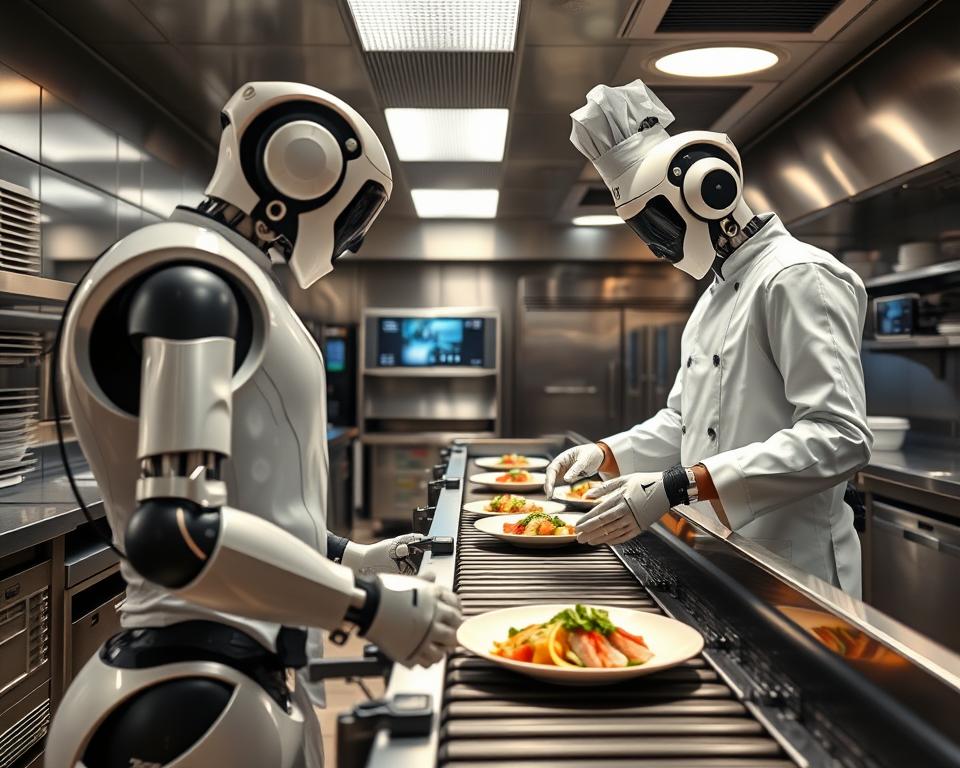
Automated fryers, conveyor pizza ovens, and robotic assists handle high‑heat or repetitive tasks. They standardize cook times and protect staff from strain and burns.
Inventory management and predictive ordering
Link inventory systems to your POS to track usage and forecast demand. That reduces waste and keeps on‑hand counts accurate.
Recipe and portion control
Recipe management and portioning tools keep dishes consistent across shifts and locations. Consistency lowers food cost and simplifies training.
Safety and environment
Smart alerts for temperature, energy use, and storage conditions improve safety and cut energy spend. Use these systems to free staff for craft work, not constant checks.
- Train back of house staff with clear SOPs that blend tools and skill.
- Track KPIs—orders per hour, error rates, and recipe variance—to tune schedules and purchases.
- Evaluate ROI across a season, not just one weekend.
For a practical guide to choosing back‑of‑house automation, see back‑of‑house automation.
Front of house and delivery: transforming the guest experience
Today’s ordering options let customers move at their own pace—scanning a code, tapping a kiosk, or ordering online. These choices reduce friction and let your staff focus on service.
Self-service ordering: kiosks, QR codes, and first‑party online menus
Offer kiosks and QR menus that link to your first‑party online ordering. Guests can browse, customize, and place orders without waiting in line.
Automated phone answering and chat
Use automated phone flows and chat to answer common questions fast. Send texts with a direct link so customers can place orders or reserve a table in seconds.
Contactless payments and automated billing
Let guests pay at the table, split checks, and tip without server steps. Contactless payments cut wait times and speed turnover during busy shifts.
Reservations, waitlists, and capacity management
Real‑time waitlist tools balance seating and reduce bottlenecks at the host stand. That improves the dining experience and lowers walkaways.
Delivery tech and POS integration
Integrate delivery platforms with your POS so all orders flow to one production queue. Provide live tracking, automated notifications, and optimized routes to protect food quality and cut driver time.
- Promote first‑party channels to reduce fees and keep customers on your platform.
- Tie delivery and orders data to staffing and inventory so you staff smarter at peak times.
- Train front house teams to steer guests toward the right option for speed or hospitality.
Conclusion
strong, The simplest path is iterative: start with one problem, add a focused tool, and measure results each week. Roll out changes in stages and link every addition to a clear business goal—shorter times, fewer errors, or lower waste.
Keep operations connected with a POS‑centric stack so inventory and management decisions use the same data. Train staff with short playbooks and support so employees adopt new workflows without losing warm service. Watch KPIs—order accuracy, ticket times, labor mix—and refine based on what the numbers show.
Protect margins with forecasting, portion control, and compliance. Use marketing thoughtfully to drive repeat visits and balance automation with human touch so guests feel cared for. Plan for the long term: retire what fails, double down on what works, and keep your house and kitchen experience central as the industry evolves.